English
 Español
 русский
Content
- 1 The Short Answer: Casting vs Forging in One Minute
- 2 How Casting Shapes Metal
- 3 How Forging Shapes Metal
- 4 Casting vs Forging: A Practical Comparison
- 5 Where Each Process Makes the Most Sense
- 6 Design Choices That Affect Cost and Quality
- 7 When the Best Answer Is Casting Plus Forging Plus Machining
- 8 Questions We Hear from Engineers and Buyers
- 9 A Final Word on Casting vs Forging
Ask ten engineers whether casting or forging is better, and you will get ten answers—but they usually start with the same question: what is the part actually doing? Casting and forging are both mature metal-forming routes, yet they shape metal in fundamentally different ways. One pours liquid metal into a mould; the other moves solid metal under pressure or impact. That difference affects grain structure, tooling, tolerances, surface finish, and the economics of a project.
At our workshop in Ningbo, we run both casting and forging work, plus CNC machining, so we rarely treat this as a philosophical debate. We treat it as a fit question. Here is a practical way to compare casting vs forging and choose the path that suits your part, your volume, and your quality requirements.
The Short Answer: Casting vs Forging in One Minute
Casting is usually the more flexible route for complex geometry. It can create internal passages, thin walls, ribs, bosses, and asymmetric shapes that would be expensive or impossible to forge. Tooling costs vary widely by process. Die casting needs steel dies and suits higher volumes; investment casting uses wax patterns and ceramic shells and can handle intricate parts at lower volumes.
Forging is usually the better route when strength, fatigue resistance, and impact toughness are central. Because the metal is deformed in the solid state, the grain flow follows the part shape, and the finished component often has fewer internal porosity risks. Forging is common for load-bearing parts such as shafts, connecting rods, steering components, and heavy equipment links. It is not a universal answer either: forging generally needs simpler geometry, more draft, and more machining allowance.
How Casting Shapes Metal
Every casting process begins with a mould, but the details matter. In die casting, molten aluminium or zinc alloy is injected into a steel die at high speed. The process is fast, repeatable, and well suited to thin walls and integrated features. Aluminium die casting is common for powertrain housings, pump bodies, motor housings, and brackets where weight reduction and dimensional consistency matter. Zinc die casting is often used for smaller gears, transmission parts, and architectural hardware because it casts sharply and needs little finishing.
Investment casting takes a different route. A wax pattern is coated in ceramic, the wax is removed, and metal is poured into the resulting shell. This allows complex shapes, fine surface detail, and alloys that are difficult to machine. Silica sol casting and water glass casting are both used for parts in automotive, agricultural machinery, rail transit, marine hardware, and construction equipment. Sand casting is still the workhorse for larger castings where cost and size matter more than fine detail.
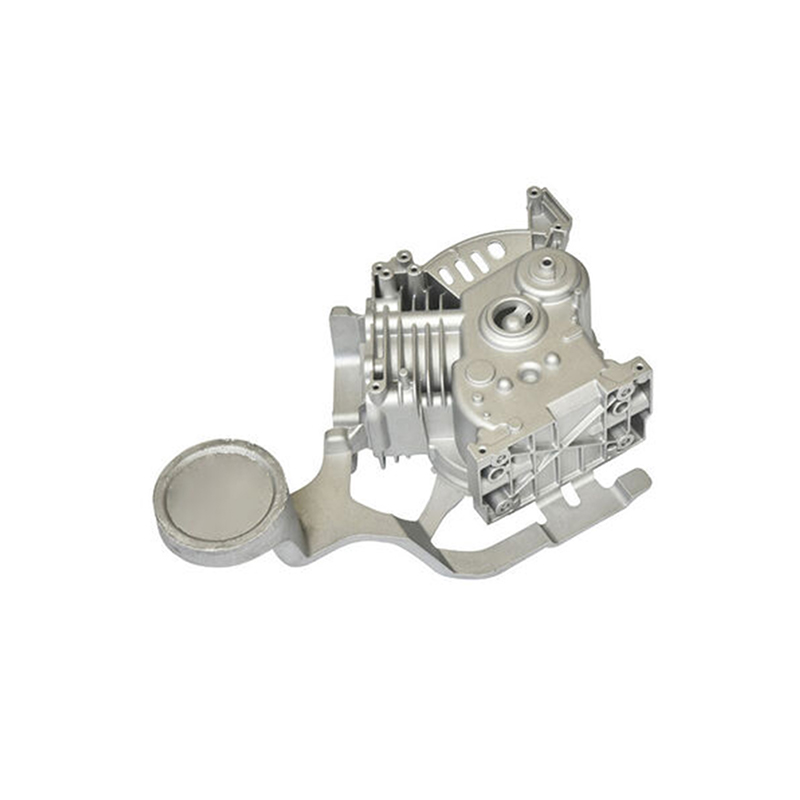 Aluminum Die-Cast Powertrain Component SeriesHigh-pressure aluminum die-cast transmission cases, cylinder heads, and oil pans use vacuum assistance and inspection to control porosity in powertrain applications.View Product →
The trade-off is that a casting can carry internal porosity if the process is not controlled. Good foundries manage gating, feeding, cooling, and inspection. When a casting will be machined, we also plan machining allowance and datum features so the finished part stays stable.
How Forging Shapes Metal
Forging starts with a billet or bar and uses heat and pressure to move the metal into shape. The solid-state deformation refines the grain structure and creates a continuous grain flow. In simple terms, the part becomes stronger in the direction the metal has been worked. That is why forged parts are often chosen for highly stressed applications: suspension components, axle parts, connecting rods, hydraulic fittings, lifting hardware, and transmission parts.
Hot forging is done above the recrystallisation temperature. It is suitable for larger, stronger parts and for shapes that need significant deformation. Hot forged automotive parts and heavy machinery components are typical examples.
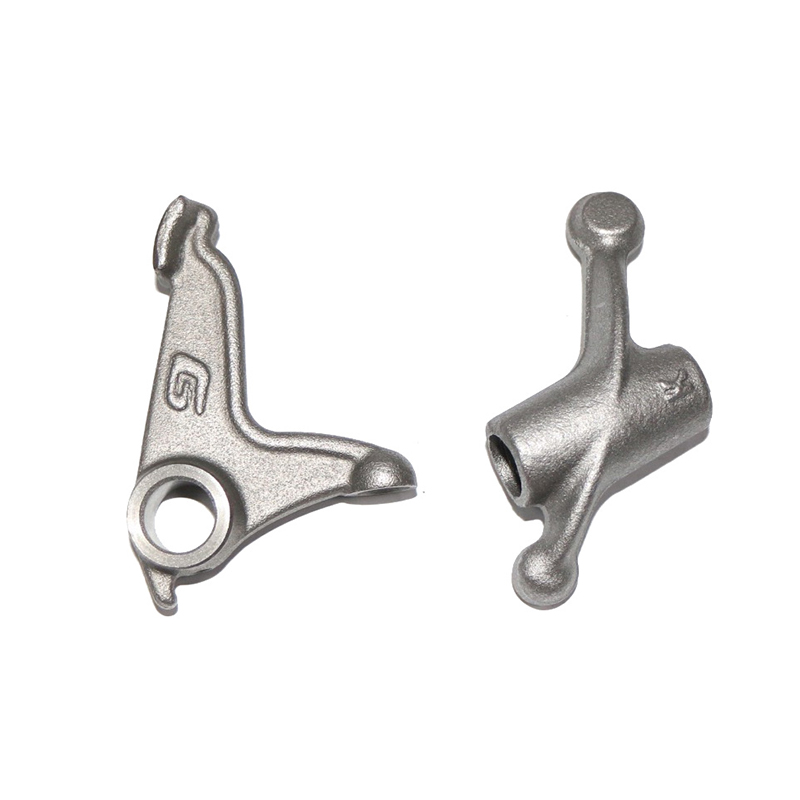 Hot Forged Automotive Component SeriesHot-forged powertrain, chassis, and steering components offer grain-flow strength and near-net-shape forming for automotive and commercial-vehicle applications.View Product →
Cold forging is performed at or near room temperature. It gives better dimensional accuracy, a smoother surface, and good material utilisation for smaller parts such as precision transmission components, door handles, lock parts, and pipe fittings.
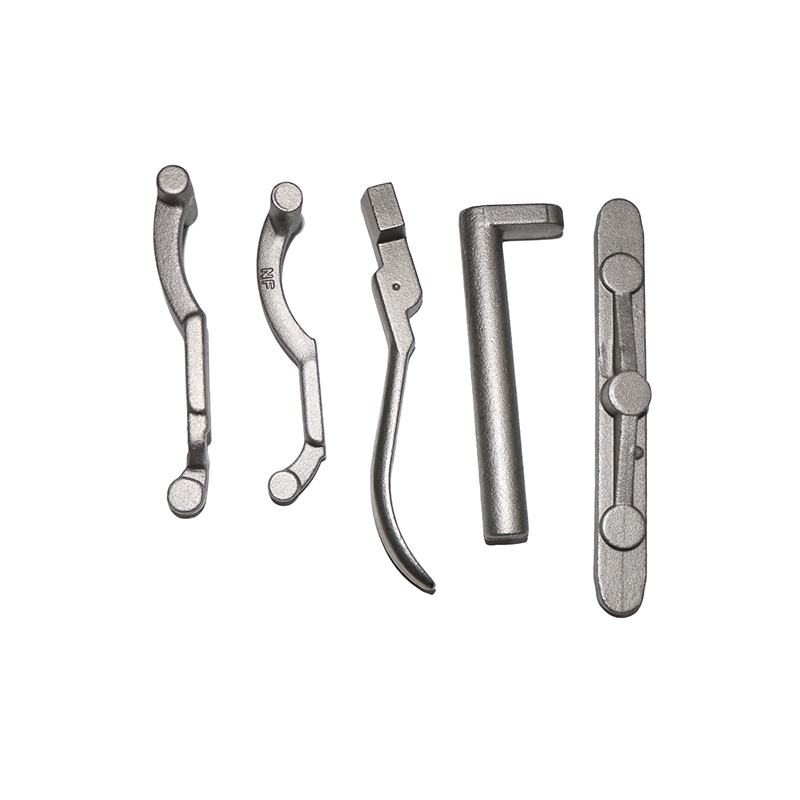 Cold Forged Precision Transmission PartsCold-forged motor shafts and door hinges use multi-station forming for tight tolerances, high material utilization, and consistent mass production.View Product →
Forging is not just about hitting metal harder. Die design, billet volume, temperature control, lubrication, and post-forge heat treatment all affect the final result. A forged part usually needs machining to reach final tolerances, but the forged preform gives the machinist a sound, predictable starting point.
Casting vs Forging: A Practical Comparison
The table below summarises the trade-offs we discuss most often with customers. It is a starting point, not a rulebook, because a single part can combine both processes.
| Factor | Casting | Forging |
|---|---|---|
| Forming principle | Liquid metal fills a mould | Solid metal is deformed by pressure or impact |
| Geometry | Complex shapes, internal passages, thin walls | Simpler shapes, draft and parting lines needed |
| Grain structure | More isotropic; porosity risk if poorly controlled | Grain flow follows shape; good fatigue resistance |
| Typical strength | Good, but depends on alloy and casting quality | Often higher toughness and fatigue performance |
| Tooling | Die casting dies are costly; investment patterns lower cost | Forging dies moderate to high; depends on volume |
| Unit cost | Lower for complex shapes and higher volumes | Competitive for strong, simple parts at volume |
| Material efficiency | Near-net shape possible; gates and risers create scrap | Less waste than machining; flash and scale occur |
| Best fit | Housings, covers, pump bodies, brackets, hardware | Shafts, rods, links, fittings, stressed structural parts |
Where Each Process Makes the Most Sense
In our project reviews, the application usually points to a short list of processes.
Casting is often the first choice for:
- Complex housings and covers with integrated ribs, bosses, or cooling features.
- Pump bodies, valve bodies, and motor housings where internal geometry matters.
- Architectural hardware, marine fittings, and decorative parts that need detailed shape.
- Larger parts where sand casting or investment casting avoids heavy machining.
Forging is often the first choice for:
- Load-bearing automotive and machinery parts that face fatigue or impact.
- Shafts, rods, links, and fittings where grain flow improves durability.
- Small, high-precision parts where cold forging reduces waste and improves finish.
- Components that will be machined after forming and need a sound internal structure.
There are also cases where neither process wins alone. A casting may be the right shape, but a forged insert or a machined interface may be needed at a high-stress joint. A forging may give the strength, but a cast or fabricated bracket may complete the assembly.
Design Choices That Affect Cost and Quality
Early design decisions often matter more than the process name. For castings, wall thickness should be as uniform as possible. Sharp corners create stress and filling problems, so radii help. Draft angles make removal from the mould or die easier. Machining allowance should be enough for cleanup but not so much that it wastes material and cycle time. For die castings, we also look at gate location, ejector pin marks, and porosity risk in thick sections.
For forgings, parting line placement, draft, fillet radii, and flash allowance shape the cost. A part that needs very tight tolerances in the as-forged condition may be expensive; often it is better to forge close to shape and then machine the critical surfaces. Grain flow direction should follow the load path. If a drawing ignores grain flow, the buyer may pay for forging and still not get the fatigue benefit.
Both processes benefit from a clear datum strategy. If the casting or forging will go into CNC machining, we need to know which surfaces locate the part, which surfaces are cosmetic, and which dimensions are critical. That conversation at the quotation stage prevents surprises later.
When the Best Answer Is Casting Plus Forging Plus Machining
Some parts are not a contest between casting and forging. They are assemblies or hybrid components. A cast housing may hold a forged shaft. A forged linkage may connect to a die-cast bracket. A machined valve body may start as a casting and receive cold-forged inserts. In those projects, the supplier's ability to coordinate multiple processes matters as much as the individual process.
At Chengen Machinery, our work covers aluminium and zinc die casting, silica sol and water glass investment casting, hot and cold forging, CNC machining, stamping, and laser cutting. We are based in Ningbo, with a 12,000 square metre production base, and we support customers who need a partner from drawing review through finished part delivery. That does not mean every project should use every process. It means we can compare the options honestly and recommend the route that fits.
Questions We Hear from Engineers and Buyers
Is casting always cheaper than forging?
No. Casting can be cheaper for complex shapes and higher volumes because it reduces machining and assembly. Forging can be more economical for strong, relatively simple parts where material waste and machining time are controlled.
Can a casting be as strong as a forging?
It depends on alloy, section design, casting quality, and heat treatment. A sound casting can perform well in many structural applications, but forging usually has an advantage in fatigue and impact resistance because of its grain flow.
Which process is better for low-volume custom parts?
Investment casting and sand casting are often practical at lower volumes. Forging may still make sense when strength is critical, but tooling and setup costs need to be weighed against the required quantity.
A Final Word on Casting vs Forging
The best choice usually becomes clear when the part's function is defined. If the priority is complex shape, integrated features, and efficient production of a housing or cover, casting deserves a close look. If the priority is fatigue strength, impact resistance, and grain flow in a load-bearing part, forging is often the stronger candidate. If the part needs both a complex body and a high-stress interface, a combined process route may be the most practical answer.
We are always happy to review a drawing, a sample, or even a rough concept. Send us the alloy, estimated annual volume, critical dimensions, and the way the part will be loaded. That is usually enough to start a useful conversation about casting vs forging, and about the machining steps that will turn either one into a reliable finished component. You can contact our team when you are ready to compare routes.